Showing posts with label Research. Show all posts
Showing posts with label Research. Show all posts
Friday, April 20, 2012
Ben Thomas: CityShrinker
To learn more about my inspiration for this project, you can view my PowerPoint presentation on Ben Thomas here.

Tuesday, April 10, 2012
A Trip to the International Center of Photography: Greg Girard
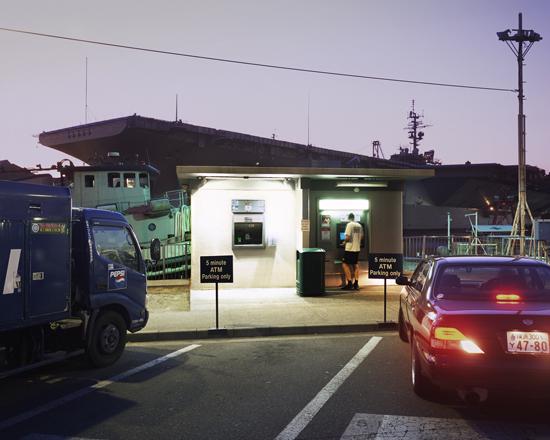 |
| ATM and Aircraft Carrier, Yokosuka Navy Base, Japan, 2008 |
All of the collections were very interesting, but one that really caught my eye was Greg Girard's collection of pictures from Japan. He took them at various American Army and Navy bases and documented how the bases can seem like a little slice of the U.S., even on the other side of the world.
The first picture that caught my eye (above), did exactly just that.Upon first glance, it looks like a picture that could have been taken right here in America. The familiar late night ATM window with 5 minute parking just outside. The Pepsi truck parked there, perhaps filling up a nearby vending machine. With a quick glance, no one would question its location. Certainly, the aircraft carrier isn't as ordinary as the rest of the scene, but a naval base in America certainly isn't questionable. The one thing that gives it away is the license plate on the car. With the rest of the night-time photography giving off a blue, purple, or green hue, the reds and oranges of the car's taillights really draw the eye. In this picture, the license plate is the one thing that suggests to the viewer that maybe this photograph wasn't taken in the country he or she originally thought it to be in.
 |
| Photography Studio Display, Okinawa, Japan, 2009 |
This next photograph has quite a different effect. When the viewer first sees it, it is easy to ascertain that this store front may be located in an Asian city. Upon closer inspection though, one will notice that one of these framed pictures is not like the others. Despite being dressed in traditional Asian clothes, the larger family portrait on the left is of an American family, unlike all the other portraits in the display. The lighting highlights the American family, and their picture more prominent. In addition, the white matte and thin frame accentuate it more than the portraits on the right with darker and more muted colors. Also, being located in the center of the picture draw the viewer's eye.
Overall, Girard's photographs were quite interesting, and I think the subject matter really made the photographs fascinating.
Sunday, February 12, 2012
Jean-François Rauzier

Jean-François Rauzier creates fantasitical, surreal panoramas out of seamlessly interlaced images. Countless hours go into creating these gigantic images (the one above measures in at 32' by 66'), but for Rauzier the creation of these Hyper-photo dreamscapes combine all of his favorite artistic mediums.
Rauzier takes close up photographs of every subject within a composition himself, allowing for much more clarity and detail than one would expect from a photograph so large. His works encourage viewers to get up close and personal with the piece, inviting them to look closer at every detail."I agree that it may sound crazy, but I've been a photographer, painter and sculptor for 30 years, exploring these different techniques of expression up until 2001. At that time, I began my Hyper-photo work and I haven't needed to do anything else. I'm entirely satisfied. As a photographer, I can use this powerful art medium to capture reality. As a painter, I can control my image exactly and put what I want where I want. And as a sculptor, I savor spending a long time on my work, as a meditation, to have the pleasure to approach, touch and feel the texture, then back away to see the entire work. Hyper-photo is a combination of all of these.”
To take a closer look at his work, check out his website, www.rauzier-hyperphoto.com.


Sources:
http://www.digitalphotopro.com/profiles/jean-francois-rauzier-the-image-is-in-the-details.html
http://www.rauzier-hyperphoto.com/bibliotheque-ideale-3/
Monday, February 6, 2012
Research: William Eggleston

Born July 27, 1939, William Eggleston is often noted as a “pioneer” of color photography. He got his first camera when he started college in 1957, and about ten years later he began to bravely explore the world of color photography while most others sat comfortably in a world of black & white. Despite criticism from his peers for not sticking with the familiar, he continued to experiment with color and light.
Eggleston’s work takes the ordinary and makes it extraordinary. He photographs common, every day events and objects and turns them into works of art. His brilliant use of color and composition sheds new light on his subjects.
His works can be considered a series because of the similarities in theme and style. Thematically, Eggleston concentrates on the ordinary, whether it be a piece of garbage, a street sign, or a person, and depicts them in a new way. Stylistically, his pictures are bold and bright, showing the world in brilliant hues.


Sources:
Subscribe to:
Posts (Atom)